
Views: 0 Author: Site Editor Publish Time: 2026-05-22 Origin: Site


Procuring components for aerospace hydraulic systems leaves zero room for error. High-pressure environments, extreme temperature fluctuations, and relentless dynamic loads require tubing that guarantees absolute consistency. You must ensure zero-fault tolerance in every single flight cycle. When sourcing AMS stainless steel tubing, buyers cannot rely on general industrial standards. A single microscopic flaw can compromise an entire flight control surface or landing gear mechanism. General specifications simply lack the rigorous testing needed for aviation safety. This guide breaks down how to identify the correct AMS specifications for your exact project needs. You will learn how to vet qualified aerospace suppliers effectively. We also detail the exact documentation you must demand to guarantee regulatory compliance, operational safety, and overall system integrity.
Aviation-Grade Verification: General ASTM standards are insufficient for aerospace hydraulics; exact AMS or MIL-T specifications (e.g., AMS 5566, MIL-T-6845) are mandatory for compliance.
Material Specifics: Selection depends heavily on the operating environment—typically 304 (1/8 hard) for standard high-pressure systems, or 321 for high-temperature/high-stress applications.
Supplier Qualification: Only purchase from suppliers maintaining AS9100 and NADCAP certifications, ensuring complete material traceability and approved non-destructive testing (NDT).
Mandatory Documentation: Never accept tubing without comprehensive Mill Test Reports (MTRs) and verifiable proof of DFARS/ITAR compliance.
General manufacturing standards work perfectly fine for commercial applications. However, they fall incredibly short when applied to flight-critical components. ASTM A269 covers general seamless and welded austenitic stainless steel tubing. It establishes basic chemical requirements and mechanical properties. Yet, it lacks the stringent quality assurance protocols necessary for aviation. It also misses the tighter dimensional tolerances and mandatory non-destructive testing (NDT) required for aerospace certification.
Hydraulic lines serve as the nervous system of an aircraft. They actuate landing gear doors. They move critical flight control surfaces like ailerons and rudders. The aerospace stainless steel tubing utilized here must resist extreme fatigue. It endures continuous pressure cycles, aerodynamic vibrations, and thermal shocks without yielding. Aerospace hydraulics demand absolute zero-fault tolerance.
To achieve this safety level, engineers rely on highly specific standards:
AMS (Aerospace Material Specifications): Published by SAE International, these standards govern precise material composition. They dictate exact physical properties, heat treatment limits, and manufacturing tolerances.
Standard Attribute | ASTM A269 (General Industrial) | AMS 5566 (Aerospace Grade) |
|---|---|---|
Testing Rigor | Basic pressure and mechanical tests. | Mandatory 100% NDT (Eddy Current/Hydrostatic). |
Traceability | Standard heat lot tracing. | Rigorous aerospace quality QA tracing required. |
Dimensional Tolerances | Standard variations allowed. | Extremely tight OD and wall thickness variations. |
Material State | Typically supplied annealed. | Often supplied 1/8 hard for elevated strength. |
Best Practice: Always check the exact revision letter of the AMS or MIL standard required on your engineering drawings. Regulatory bodies update these standards periodically. Subtle updates can drastically change compliance testing requirements or reject previously acceptable material states.
Material selection depends entirely on the aircraft's operating environment. You need to match the specific alloy and temper to the system's mechanical demands. Choosing the wrong alloy can lead to premature fatigue or corrosive failure.
Type 304 remains the most commonly specified material for aviation hydraulic lines. It expertly balances ductility, cold-forming capability, and environmental corrosion resistance. The "L" designation indicates a lower carbon content, which prevents sensitization during welding procedures.
Key Standards: AMS 5566, AMS 5564, MIL-T-6845.
Material Condition: Suppliers often provide these tubes in a "1/8 hard" state rather than a fully annealed condition. This hardening process achieves the ultimate tensile strength (105-140 KSI) required to convey high-pressure hydraulic fluid safely.
Certain aircraft sections generate extreme heat. Standard alloys degrade rapidly under these conditions. Type 321 incorporates titanium stabilization. This precise addition prevents carbide precipitation, also known as sensitization, during elevated temperature exposure.
Key Standards: AMS 5557 and AMS 5570. AMS 5557 Type 1 dictates cold-drawn precision manufacturing. Type 2 dictates hot-finished processes.
Ideal Applications: Engineers specify Type 321 for systems routed near engine compartments, exhaust ducts, or auxiliary power units (APUs).
The manufacturing process directly impacts the tube's structural integrity. Seamless tubing originates from a solid billet extruded into a hollow tube. It contains no longitudinal weld seams. This provides maximum pressure ratings and unparalleled structural integrity for flight-critical applications. Conversely, welded and drawn tubing starts as a rolled strip welded closed. It is acceptable in specific secondary fluid systems. However, mills must strictly manufacture and test it to aerospace standards to ensure the weld seam disappears completely.
Common Mistake: Specifying fully annealed tubing for high-pressure systems. If your hydraulic system requires extensive flaring or bending during installation, ensure the tubing specifies a compatible hardness state. The 1/8 hard temper permits cold working without cracking while maintaining high burst-pressure ratings.
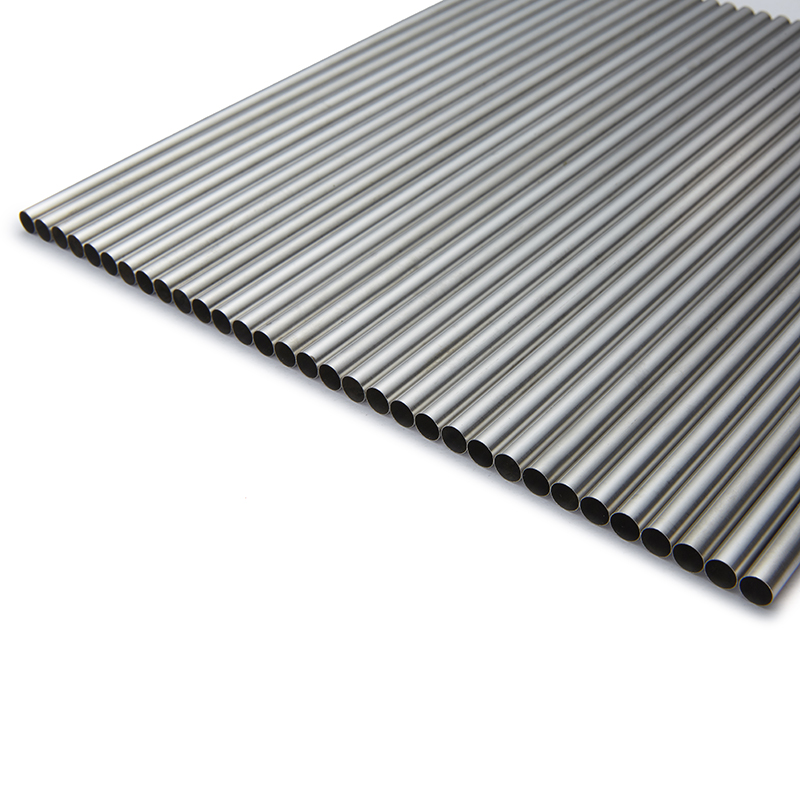
Precision aerospace stainless steel tubing optimized for high-pressure hydraulic fluid conveyance.
Finding a capable supplier goes well beyond checking a product catalog. The aerospace supply chain is heavily regulated. You must verify their quality management and compliance frameworks rigorously before issuing a purchase order.
Quality Management Systems (QMS): ISO 9001 serves as a mere baseline for commercial industry. True aerospace suppliers must hold active AS9100 certification. This aerospace-specific standard mandates rigorous supply chain risk management. It also requires comprehensive counterfeit parts prevention programs to keep unverified metals out of the aviation ecosystem.
Inventory & Storage Controls: Qualified distributors must demonstrate strict environmental facility controls. They must prevent cross-contamination meticulously. For example, they must physically isolate carbon steel cutting areas away from stainless stock to prevent rust transfer. They must also utilize secure end-capping protocols to prevent internal oil, dust, or debris contamination during storage.
Never finalize a purchase or accept a shipment without securing the required documentation. A strict documentation checklist protects your supply chain liability and guarantees flight safety.
Mill Test Reports (MTRs): These authoritative documents must accompany every single shipment. They verify the exact chemical composition from the original steel melt. For instance, a 304 MTR must prove 18-20% Chromium and 8-11% Nickel content. They also record the batch's baseline mechanical properties.
Destructive Testing Proof: You must secure documentation verifying the specific batch passed physical tests. Quality engineers subject tubing samples to flaring, flanging, and reverse flattening tests. The metal must endure these deformations without cracking or splitting.
Non-Destructive Testing (NDT) Records: Demand proof of NDT. Eddy current testing uses electromagnetic fields to detect microscopic surface cracks. Hydrostatic testing forces pressurized water inside the tube to locate invisible pinhole leaks. These records guarantee wall integrity.
Dimensional Tolerances: Request verification that the outer diameter (OD) and wall thickness comply with strict variations. Standards like MIL-T-6845 dictate exceedingly tight tolerances. Engineers need these tight geometric margins to calculate safe operating pressures accurately.
Crucial Warning: Do not accept basic "certificate of conformance" letters in place of actual MTRs for critical aerospace hydraulic tubing. Certificates merely state the product meets a standard. Engineers need the raw, empirical test data found on an MTR to verify safety margins.
Choosing the right procurement channel impacts both project timelines and component availability. Buyers generally choose between two primary avenues: direct mill purchases and specialized master distributors.
Sourcing Channel | Best Suited For | Primary Advantage | Main Drawback |
|---|---|---|---|
Direct from Mills | High-volume OEM production runs. | Highest level of custom OD/wall thickness combinations. | Long lead times, frequently spanning several months. |
Aerospace Master Distributors | MRO (Maintenance, Repair, Overhaul) and agile builds. | Ready-to-ship inventory with pre-filed certifications. | Limited to standard catalog sizes and predefined conditions. |
When balancing cost and availability, you must evaluate vendor lead times against associated risks. Prioritize suppliers who perform in-house cutting, deburring, and packaging strictly to aerospace standards. Poor packaging often leads to transit damage. A slightly bent precision tube end renders the entire component useless for flight installations.
Sourcing certified AMS tubing requires navigating a strict landscape of material science, regulatory compliance, and rigorous quality assurance. You cannot compromise on documentation or material temper. By strictly enforcing your engineering requirements, procurement teams can securely mitigate supply chain risks.
Always verify specific AMS or MIL-T codes against your engineering drawings before issuing any purchase order.
Prioritize the correct material hardness, such as the 1/8 hard temper, to balance hydraulic burst pressure with installation bendability.
Demand raw, empirical data through comprehensive Mill Test Reports rather than settling for generic conformance certificates.
Take immediate action by reviewing your current vendor list. Ensure they hold the necessary aerospace accreditations.
A: While both cover 304 stainless steel tubing, AMS 5566 is specific to aerospace applications. It requires tighter dimensional tolerances and specific hardness states, like 1/8 hard for high pressure. AMS 5566 also mandates far more rigorous traceability and non-destructive testing than the general-purpose ASTM A269 standard.
A: The "1/8 hard" temper provides a critical balance. It increases the yield and tensile strength of the stainless steel to withstand high-pressure hydraulic fluids. At the same time, it retains enough ductility to allow for the flaring and bending required to fit tubing into complex aircraft bulkheads.


