- Home
- Products
- About Us
- Quality
- Application
- Services & Support
- Blogs
- Contact
Views: 0 Author: Site Editor Publish Time: 2026-01-12 Origin: Site


You see titanium seamless pipes start as solid billets and transform into high-performance tubes through advanced processes. Each stage, from selecting premium titanium alloys to precise forming and finishing, ensures pipes deliver unmatched strength and reliability.The titanium seamless pipe market reached about USD 1.2 billion in 2023 and continues to grow, fueled by rising demand in aerospace, marine, and energy sectors.Manufacturing involves careful material selection, inspection, heating, extrusion, rolling, and finishing—each step designed for precision and quality.
Choosing the right titanium alloy is crucial for making strong and reliable seamless pipes. Grade 2 is ideal for chemical processing, while Grade 5 is perfect for aerospace applications.
The manufacturing process involves several steps, including heating, extrusion, and rolling, which ensure the pipes achieve the desired strength and dimensions.
Quality control is essential. Rigorous inspection methods like ultrasonic and hydrostatic testing help ensure each pipe meets strict safety and performance standards.
Proper packaging and certification provide customers with confidence in the quality and reliability of titanium seamless pipes, ensuring they are safe for demanding applications.
Titanium seamless pipes offer significant advantages, including high corrosion resistance, lightweight properties, and exceptional strength, making them suitable for various industries.
When you start making Titanium Seamless Pipes, you need to choose the right titanium alloy. At Huashang, you get only high-quality titanium alloys that meet strict international standards. These standards include ASTM B338, ISO 9713:1999, and EN 3888. They make sure your pipes have the right chemical makeup, strength, and size.
Here is a table to help you understand the most common titanium alloys used for seamless pipes:
Property | Grade 2 (Unalloyed Titanium) | Grade 5 (Ti-6Al-4V) |
|---|---|---|
Composition | Commercially pure titanium (99%+ Ti) | 90% Ti, 6% Al, 4% V |
Tensile Strength | 345 MPa (min) | 895-930 MPa |
Yield Strength | 275 MPa (min) | 825 MPa (min) |
Primary Advantages | Excellent corrosion resistance, formability, cost-effectiveness | High strength-to-weight ratio, fatigue resistance |
Typical Applications | Heat exchangers, chemical processing equipment | Aerospace components, marine fittings, medical implants |
You can see that Grade 2 works well for chemical plants and heat exchangers. Grade 5 is best for airplanes and ships because it is very strong and light.
After you pick the alloy, you need to turn titanium ore into billets and bars. This process happens at Huashang’s advanced facility, in partnership with YONGSHANG factory. You start by extracting titanium from minerals like rutile or ilmenite. The ore is refined to remove impurities, then melted in a vacuum or argon atmosphere. This keeps the titanium pure.
Next, you cast the molten titanium into ingots or billets. You forge or extrude these billets into bars. Sometimes, you use hot rolling and annealing to get the right size and strength. You may also use heat treatment to make the metal even better. Finally, you machine and finish the bars so they are ready for the next step in making Titanium Seamless Pipes.
Tip: Using advanced methods like preheating, forging, and surface treatments helps you get billets and bars with the best properties for seamless pipe production.
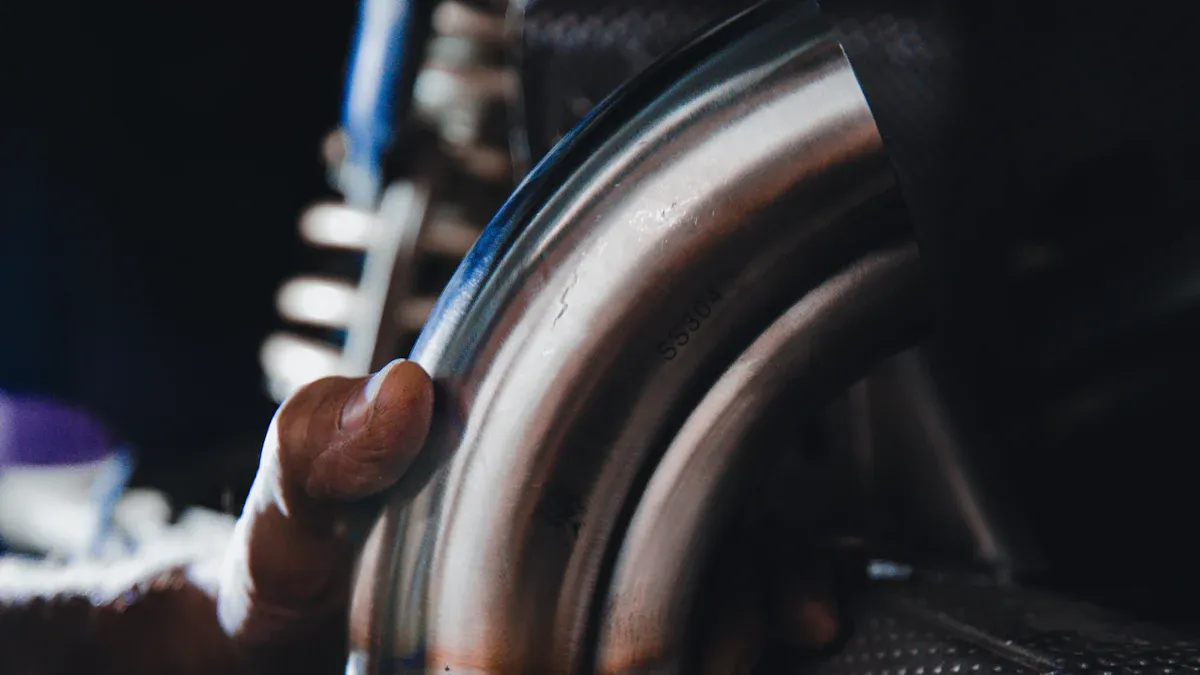
You start the pipe-forming process by heating the titanium billet. This step makes the metal soft and easy to shape. You must heat the billet to a precise temperature. For example, 1050°C works best for Ti80 titanium alloy. This temperature gives you better control over the pipe’s size and shape than lower temperatures like 850°C or 950°C.
Here is a table showing the main steps in this stage:
Step | Description |
|---|---|
Heating | You heat the billet to a specific, precise temperature to make it malleable. |
Piercing | A piercing mill punctures the center of the solid billet to create a hollow "shell." |
You can see how different temperatures affect the process:
Temperature (°C) | Description |
|---|---|
1050 | Optimal piercing temperature for Ti80 titanium alloy, resulting in better dimensional accuracy compared to 850 °C and 950 °C. |
950 | Intermediate piercing temperature, also less dimensional accuracy than 1050 °C. |
850 | Lower piercing temperature, less dimensional accuracy. |
Tip: Using the right temperature helps you get Titanium Seamless Pipes with the best quality and size.
After you create a hollow shell, you move to the extrusion and Mannesmann method. In extrusion, you push the hot titanium shell through a die. This step shapes the pipe and makes the metal grains smaller, which improves strength. You must control the pressure and speed carefully because titanium resists deformation.
The Mannesmann method is also important for making Titanium Seamless Pipes, especially when you need larger diameters and thick walls. Here is how the Mannesmann method works:
The Mannesmann effect forms a cavity in the bar during radial compression.
This effect happens during both cold and hot deformation.
Rotary tube piercing uses this effect to create long, thick-walled seamless pipes.
The Mannesmann method is used for producing seamless pipes, especially for larger diameters and wall thicknesses.
It includes a piercing process followed by elongation to form a hollow shell.
This method is important for titanium because of its unique properties.
Note: The combination of extrusion and the Mannesmann method helps you make pipes that are strong and have the right shape.
Next, you use hot rolling and elongation to refine the pipe. You heat the hollow shell again and roll it between large rollers. This step stretches the pipe and makes the walls thinner and more even. Hot rolling also improves the pipe’s strength and durability.
Here are some advantages of hot rolling and elongation:
Advantage | Description |
|---|---|
High Production Efficiency | Hot rolling allows for the rapid production of seamless pipes, increasing output. |
Low Cost | The process is cost-effective due to reduced material waste and energy consumption. |
Improved Mechanical Properties | Refinement of the steel structure enhances strength and durability. |
Desired Shape and Dimensions | Elongation helps achieve specific shapes and sizes required for various applications. |
During hot rolling, you see big changes in the pipe’s size. For example, the first passes can reduce the wall thickness by 60%. In the final passes, you can reach a thickness as low as 3 mm. The temperature can reach up to 1100°C in the last steps.
Process Step | Temperature (°C) | Thickness Reduction (%) | Final Thickness (mm) |
|---|---|---|---|
Initial Passes | 1000, 1025, 1050 | 60 | N/A |
Final Passes | 1100 | 50 | 3 |
Hot rolling and elongation help you get Titanium Seamless Pipes with the exact size and strength you need for tough jobs.
You improve the strength and accuracy of pipes with cold pilgering and drawing. Cold pilgering uses powerful rollers to squeeze and stretch the pipe. This process gives you pipes with high strength and smooth surfaces. You also get very precise sizes. Cold pilgering works well for metals like titanium that are hard to shape. After cold pilgering, you use drawing to pull the pipe through a die. This step makes the pipe even straighter and more uniform.
You must watch several key parameters during these steps:
Parameter | Description |
|---|---|
Die Rolling Rate | How fast the die rolls during the process |
Pipe Movement | How the pipe moves after each processing step |
Tool Geometry | The shape and design of the tools you use |
Feed Rate | The speed at which you feed material into the process |
Rolling Speed | How fast the rolls operate |
Roll Angle | The angle of the rolls, which affects deformation |
Tip: Careful control of these parameters helps you get pipes with the best mechanical properties.
You use heat treatment to change the structure of efficient titanium pipes. This step makes the pipes stronger and tougher. If you heat the pipe above a certain temperature, you get a strong but less corrosion-resistant pipe. If you heat it below that point, you get a balance of strength and corrosion resistance. You can also use precipitation hardening. This method puts tiny particles inside the metal, making it harder and stronger. You control the final properties by adjusting the temperature and time.
You finish the surface to protect the pipe and make it look better. You can use mechanical cleaning with brushes or pads to remove dirt. Chemical cleaning uses special solutions to get rid of oil and grease. Pickling removes oxide layers and prepares the pipe for welding. These steps help the pipe resist corrosion and last longer.
Here is a table showing common finishing processes and their purposes:
Finishing Process | Purpose |
|---|---|
Straightening | Ensures perfect linearity |
Cutting | Achieves the required length |
Surface finishing | Improves surface quality (polishing, pickling) |
Non-Destructive Testing | Ensures quality through rigorous inspection |
Ultrasonic Testing | Detects internal flaws |
Eddy Current Testing | Identifies surface and near-surface defects |
Hydrostatic Testing | Verifies pressure integrity |
Dimensional Checks | Ensures compliance with strict tolerances |
Note: These finishing steps make sure Titanium Seamless Pipes meet the highest standards for quality and performance.
You need to make sure every pipe meets strict quality standards. At Huashang, you follow a series of inspection and testing steps to check for defects and ensure safety. You use advanced tools like laser micrometers and optical systems to measure each pipe’s size. This helps you keep the pipes within tight tolerances. You also check the metal’s structure and strength to make sure it will last in tough conditions.
Here is a table showing the main inspection methods and their purposes:
Inspection Method | Purpose |
|---|---|
Eddy Current Inspection | Detects surface imperfections |
Ultrasonic Verification | Assesses suspected defect areas |
Hydrostatic Proof Testing | Validates integrity for critical uses |
Corrosion Testing | Checks resistance to rust and chemicals |
Intergranular Corrosion Assessment | Tests for grain boundary corrosion |
Surface Roughness Control | Ensures smooth surfaces |
You also use non-destructive testing. This means you can find problems without harming the pipe. You follow international standards like ISO9001:2015 and ISO13485:2016. These steps help you deliver Titanium Seamless Pipes that are safe and reliable.
Tip: Careful inspection and testing help you avoid costly failures in the field.
You must provide certificates to show your pipes meet global standards. These include ASTM B338 and ASTM B861. Each certificate lists the chemical makeup and mechanical properties of the pipe. This gives your customers confidence in the product.
Standard | Description |
|---|---|
ASTM B338 | Sets rules for seamless titanium tubes for corrosion and high temperatures |
ASTM B861 | Covers seamless titanium tubes for general and high-temperature service |
Proper packaging keeps pipes safe during shipping and storage. You inspect each pipe, clean it, and wrap it in plastic film. You bundle pipes with steel bands and label them clearly. You use the right equipment to load and unload pipes, so they do not get damaged.
Step | Description |
|---|---|
Pre-transport Preparation | Inspect, clean, and protect pipes with plastic film |
Packaging | Bundle pipes, use strong containers, and label them |
Loading and Unloading | Handle pipes with care and proper equipment |
Note: Good packaging and clear certification help you deliver quality pipes to customers around the world.
You follow many careful steps to make titanium seamless pipes. Each stage, from choosing pure titanium to final inspection, matters for strength and safety. Huashang meets top standards, like ISO 9001:2015 and ASTM B338, which boost quality and trust.
Certification | Overview | Benefits |
|---|---|---|
ISO 9001:2015 | Quality management system | Better efficiency and customer satisfaction |
ASTM B338 | Seamless titanium tube standard | Reliable performance and global acceptance |
Titanium seamless pipes give you these advantages:
High corrosion resistance for harsh places
Lightweight for better fuel use
Strong and tough for extreme jobs
You can count on seamless pipes for your most demanding projects.
You get seamless pipes without any welds. This means you see higher strength and better pressure resistance. Welded pipes have a seam that can be a weak point. Seamless pipes work better for high-stress jobs.
You use these pipes in oil and gas, chemical plants, aerospace, and marine engineering. They handle high pressure, heat, and corrosion. You can trust them in tough environments.
You use tests like ultrasonic, eddy current, and hydrostatic testing. You also check the size and surface. These steps help you find defects and make sure each pipe meets strict standards.
You get pipes made with advanced technology and strict quality checks. Huashang follows international standards. You receive reliable products for your projects.