- Home
- Products
- About Us
- Quality
- Application
- Services & Support
- Blogs
- Contact
Views: 0 Author: Site Editor Publish Time: 2026-01-07 Origin: Site


A titanium seamless pipe is a tube made from titanium with no weld seam along its length. A welded titanium pipe has a visible seam where two edges join. The lack of weld seam in seamless pipes increases their pressure resistance and strength. You also get better corrosion resistance because there are no weak points from welding. The table below shows how seamless and welded pipes compare for strength and corrosion resistance:
Pipe Type | Strength Characteristics | Corrosion Resistance Characteristics |
|---|---|---|
Seamless Pipes | Higher pressure resistance and strength | Uniform corrosion resistance, no weak points due to welds |
Welded Pipes | Modern welding technology ensures weld quality | May require special treatment for seams to resist corrosion |
Titanium seamless pipes have no weld seams, making them stronger and more resistant to pressure than welded pipes.
Seamless pipes offer better corrosion resistance because they lack weak points from welding, making them ideal for harsh environments.
Welded pipes are often more cost-effective and can be produced in larger sizes, but they may have weaker areas at the weld seams.
Choose seamless pipes for critical applications where safety and reliability are essential, such as aerospace and chemical processing.
For less demanding uses or larger projects, welded pipes can be a suitable and economical option.

A titanium seamless pipe is a tube made from a single piece of high-purity titanium. You will not find any weld seam along its length. Manufacturers start by selecting titanium billets, which they process through several steps to create a hollow tube. The process includes piercing, hot and cold rolling, and heat treatment. This method gives the pipe a uniform structure and consistent wall thickness.
You can see the typical size and tolerance ranges for these pipes in the table below:
Parameter | Standard Range | Precision Grade | Applicable Standards |
|---|---|---|---|
Outer Diameter | 6-50 mm | ±0.1-0.3 mm | ASTM B337, ASME B36.19M |
Wall Thickness | 0.5-5 mm | ±5-10% | ASTM B338, ASME SB338 |
Length | 3-6 meters | ±5 mm/meter | Custom specifications |
Straightness | - | <0.5 mm/meter | Industry standards |
The absence of a weld seam means you get a pipe with higher strength and better pressure resistance. This makes titanium seamless pipe ideal for demanding environments.
A welded titanium pipe starts as a flat sheet or strip of titanium. You will see manufacturers roll the sheet into a cylindrical shape and then join the edges using welding techniques like TIG welding. After welding, the pipe goes through heat treatment to improve its properties.
The main steps in making a welded titanium pipe include:
Material selection based on the application.
Preparing titanium sheets.
Rolling the sheets into a cylinder.
Welding the edges together.
Annealing the pipe for better strength.
Welded pipes often come in larger diameters and can be more cost-effective for many uses. However, the weld seam can create a weak point, especially under high pressure or in corrosive environments.
When you compare titanium seamless pipe and welded titanium pipe, you notice several important differences:
Structure: Seamless pipes have no weld seam. Welded pipes have a visible seam along their length.
Manufacturing Process: Seamless pipes use a billet and go through piercing and rolling. Welded pipes start as sheets and require welding.
Mechanical Properties: The seamless design gives you higher strength and pressure resistance. Welded pipes may have weak points near the weld seam.
Wall Thickness Control: Seamless pipes offer more uniform wall thickness. Welded pipes can show slight variations near the seam.
Size Range: You will find seamless pipes mostly in smaller diameters. Welded pipes are available in larger sizes.
Cost: Seamless pipes usually cost more due to the complex process. Welded pipes are more economical for many projects.
Tip: If you need a pipe for high-pressure or critical applications, you should choose a titanium seamless pipe. For less demanding uses or larger sizes, welded titanium pipe may be the better option.
Here is a quick comparison table:
Feature | Titanium Seamless Pipe | Welded Titanium Pipe |
|---|---|---|
Raw Material | Titanium billet/ingot | Titanium strip/coil |
Process | Piercing, rolling, annealing | Rolling, welding, annealing |
Weld Seam | None | Present (longitudinal) |
Wall Thickness Control | Uniform and consistent | Slight variation near weld |
Size Range | Small OD (<114mm) | Large OD (>114mm) |
Cost | Higher | More economical |
Strength | Superior, no weak points | Good, but weld seam is weaker |
Pressure Resistance | Higher | Lower |
Corrosion Resistance | Enhanced | Good, but seam may corrode |
You can see that the absence of a weld seam in a titanium seamless pipe leads to better mechanical properties. The seamless structure gives you higher reliability, especially when you need to handle high pressure or harsh chemicals.
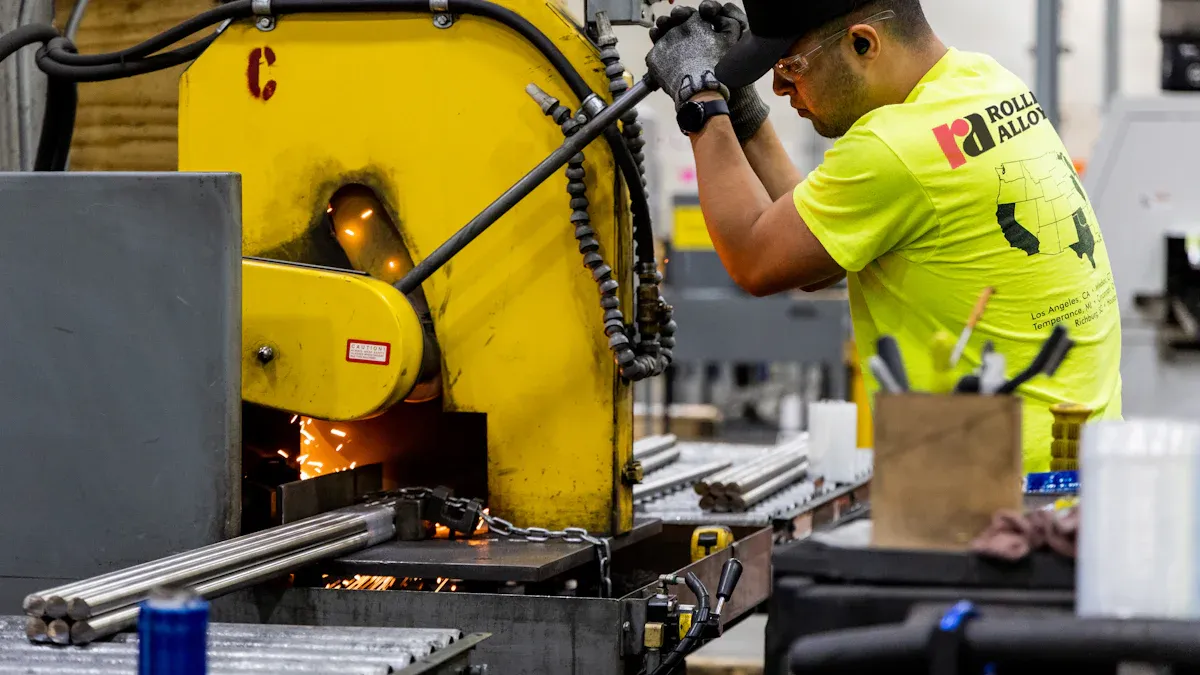
You will see that making a titanium seamless pipe starts with a solid titanium billet. Workers heat the billet and pierce it to create a hollow tube. They use rolling and drawing machines to stretch and shape the tube until it reaches the desired size. This process uses rolling and drawing oils, which can raise production costs and cause environmental concerns. The choice of raw materials, such as titanium coil strips, affects the efficiency and quality of the final pipe. Seamless pipes have a lower yield, with only about half of the starting material becoming finished product. This means more waste, but you get a pipe with a uniform structure and consistent strength.
Welded titanium pipe production uses a different approach. You start with high-purity titanium plates or strips. The steps include:
Select and clean the titanium plate or strip to remove impurities.
Roll or extrude the material into a tube shape.
Weld the edges using TIG or PAW welding with argon gas shielding.
Treat the weld with pickling or grinding to improve corrosion resistance.
Apply heat treatment, such as annealing, to strengthen the welded joint.
Inspect and test the pipe for appearance, mechanical properties, and corrosion resistance.
This method allows you to use more of the raw material, with a utilization rate above 95%. Welded pipes can be made in larger sizes and are often more cost-effective.
The way you make titanium pipes changes their quality and consistency. Seamless tubes made by extrusion offer better mechanical properties and a more even strength distribution. Welded tubes may show differences in strength and durability, especially near the weld seam. The microstructure of welded pipes depends on welding methods, cooling rates, and heat treatment. For example, high cooling rates can create a rough needle structure, while proper annealing improves corrosion resistance and reduces weak zones. The table below shows how different manufacturing factors affect welded pipe quality:
Factor | Effect on Welded Pipe Quality |
|---|---|
Welding Method | Changes microstructure and weld zone width |
Cooling Rate | Alters structure and crack resistance |
Annealing Temperature | Improves corrosion resistance and reduces weak zones |
Processing Parameters | Affects bending capability more than impact toughness |
Note: The manufacturing method you choose will decide the pipe's strength, durability, and best use. Seamless pipes give you more reliable performance for demanding jobs, while welded pipes offer flexibility and lower cost for less critical tasks.
You need to know how pipes perform under stress. Titanium seamless pipe stands out for its strength. The pipe has no weld seam, so it handles high pressure better than welded pipes. You can see the difference in the table below:
Pipe Type | Tensile Strength (MPa) | Max Pressure Rating (Est.) |
|---|---|---|
Seamless | ≥895 (Gr5) | ~100 MPa |
Welded | Lower than seamless | Lower than seamless |
Seamless tubes also show higher pressure ratings. Welded pipes have a weak spot at the seam, which limits their use in high-pressure systems. If you need a pipe for hydraulic systems or aerospace, seamless is the safer choice.
Titanium resists corrosion in many tough environments. You get strong protection against chemicals like chlorides, which often damage other metals. Here are some facts about corrosion resistance:
Titanium resists pitting from chlorides.
It works well in acid environments with ferric and cupric ions.
Titanium seamless pipe is highly resistant to steam and caustic conditions.
Grade 2 titanium tubing performs well in oil and gas, seawater cooling, and desalination plants.
Annual corrosion rate in seawater and nitric acid is less than 0.02mm, much better than stainless steel.
The weld seam is identified as the main anode that accelerates corrosion, while the base metal and heat-affected zone exhibit better corrosion resistance. This leads to a higher likelihood of corrosion failure occurring at the welded joint compared to the base metal alone.
Seamless pipes avoid these weak points, so you get more reliable corrosion protection.
You want pipes that last in harsh conditions. Titanium seamless pipe proves its value in chemical plants, offshore oil rigs, and military ships. These pipes work well for underwater pipelines and fluid transfer systems on offshore platforms. Over the past 20 years, titanium has become the top choice for offshore equipment. It stands up to saltwater, high pressure, and constant use.
Seamless pipes have uniform strength and resist microcracks.
Welded pipes work best in non-critical stress situations.
Seamless pipes are used in ship hulls, underwater pipelines, and oil rigs.
Welded pipes may need extra care in corrosive or high-stress environments.
If you need reliability for decades, seamless pipes offer proven performance and lower maintenance.
You will find titanium seamless pipe in industries that demand high strength and reliability. These pipes work well in places where you need to handle extreme pressure, temperature, or corrosion. Here are some common uses:
Aerospace
Architectural
Automotive
Chemical Processing
Heat Exchangers
Marine
Medical
Military and Defense
Oil and Gas
Power Generation
Titanium seamless pipe stands out because it meets strict performance requirements. You see it used in hydraulic systems for aircraft, fuel lines, engine parts, and medical implants. The table below shows how different industries rely on specific properties:
Performance Requirement | Industry Applications |
|---|---|
Strength | Aerospace, Oil & Gas, Medical Devices |
Corrosion Resistance | Chemical Processing, Marine Applications |
Temperature Tolerance | Aerospace, Power Generation |
Compliance with Standards | All industries utilizing titanium seamless pipe |
You choose this pipe when you need durability, safety, and long service life.
Welded titanium pipes offer flexibility for many projects. You see them used in chemical plants, oil and gas fields, and power stations. These pipes handle high pressure and temperature, making them suitable for transporting oil, natural gas, water, and steam. Large diameter welded pipes help move fluids efficiently. You can rely on them for safe and reliable pipeline systems.
Chemical Processing: Handles corrosive materials
Oil and Gas: Used in wells and pipelines
Aerospace: Good for fatigue resistance
Power Generation: Works in condensers and boiler tubes
Low-pressure fluid transport: Water, air, heating steam
Welded pipes give you a cost-effective solution for less critical or large-scale applications.
You need to think about cost when choosing between seamless and welded pipes. Welded fittings cost less because manufacturers produce them faster and use less material. These pipes suit projects with tight budgets. Seamless fittings cost more at first, but you get better strength and reliability. You should pick seamless pipes for critical jobs where safety matters most.
Type of Pipe | Cost Considerations | Suitability for Applications |
|---|---|---|
Welded Fittings | Lower manufacturing costs and faster production times | Best for budget-sensitive projects |
Seamless Fittings | Higher initial costs, superior strength and reliability | Ideal for safety-critical applications |
Tip: If your project needs top performance and long-term safety, invest in titanium seamless pipe. For general use or large pipelines, welded pipes help you save money.
You need to make sure titanium seamless pipes meet strict quality standards. Manufacturers check every step, from raw material to finished pipe. They use several tests and inspections to guarantee performance and safety. Here is a table that shows the main quality control aspects for seamless pipes:
Quality Control Aspect | Description |
|---|---|
Chemical Composition | Limits for each element in the alloy to ensure the pipe works in tough places. |
Mechanical Properties | Checks for strength and pressure resistance, like tensile and yield strength. |
Dimensional Tolerances | Ensures the pipe has the right diameter, wall thickness, and length. |
Quality Assurance Tests | Includes hydrostatic and electric tests to confirm the pipe’s quality. |
Material Selection | Uses only titanium that meets chemical standards. |
Production Process Control | Monitors steps like extrusion for consistency. |
Testing and Inspection | Regular checks for strength and size, often using non-destructive methods. |
Certification | Provides proof that the pipe meets ASTM standards. |
You will see non-destructive testing (NDT) used to find hidden flaws. Common NDT methods include:
Ultrasonic testing: Finds cracks or voids inside the pipe.
Eddy current testing: Detects surface and near-surface defects.
Liquid penetration testing: Spots surface-breaking defects.
These tests help you trust that seamless pipes are safe for high-pressure and critical jobs.
Welded titanium pipes need extra checks, especially at the weld seam. You want to make sure the weld is strong and leak-free. Here is a table showing standard testing procedures for welded pipes:
Inspection Method | Application |
|---|---|
Ultrasonic Testing (UT) | Checks shells and important welds for hidden flaws. |
X-ray Radiography | Looks inside the weld to find defects. |
Dye Penetrant Testing | Finds surface cracks in flanges or tube welds. |
Helium Leak Testing | Confirms gas-tightness in chemical-grade pipes. |
WPS and EN 10204 3.1 | Tracks material and weld quality for safety records. |
You will also see some differences in quality control between seamless and welded pipes. For example, seamless pipes often use ultrasonic testing for internal flaws, while welded pipes rely on eddy current testing for weld integrity. Both types go through chemical checks, dimensional inspections, and hydrostatic pressure tests. Surface finish gets checked with special tools to make sure it is smooth and safe.
Tip: Always look for pipes with proper certification and test records. This helps you avoid problems and ensures your system runs safely.
You now know the main differences between titanium seamless and welded pipes. Seamless pipes have no weld seam, so they offer higher strength and better pressure resistance. Welded pipes give you more size options and cost savings. Use this table to help you choose:
Type of Pipe | Recommended For |
|---|---|
Seamless Titanium Pipes | Extreme high-pressure jobs, critical or hazardous service, high thermal cycling |
Welded Titanium Pipes | Large diameter systems, budget projects, standard corrosive services |
Understanding these differences helps you pick the safest and most effective pipe for your project.
You get higher strength and better pressure resistance. The seamless design removes weak points, so you can trust the pipe in critical or high-pressure jobs.
Yes, you can use welded pipes in many corrosive settings. You should check the weld seam for extra protection. Some projects need special treatment to keep the seam safe from corrosion.
You should look at your project’s needs. Choose seamless pipe for high pressure or safety-critical jobs. Pick welded pipe for larger sizes or when you want to save money.
No, you can install titanium pipes with standard tools. You may need skilled workers for welding or joining. Always follow the manufacturer’s guidelines for best results.